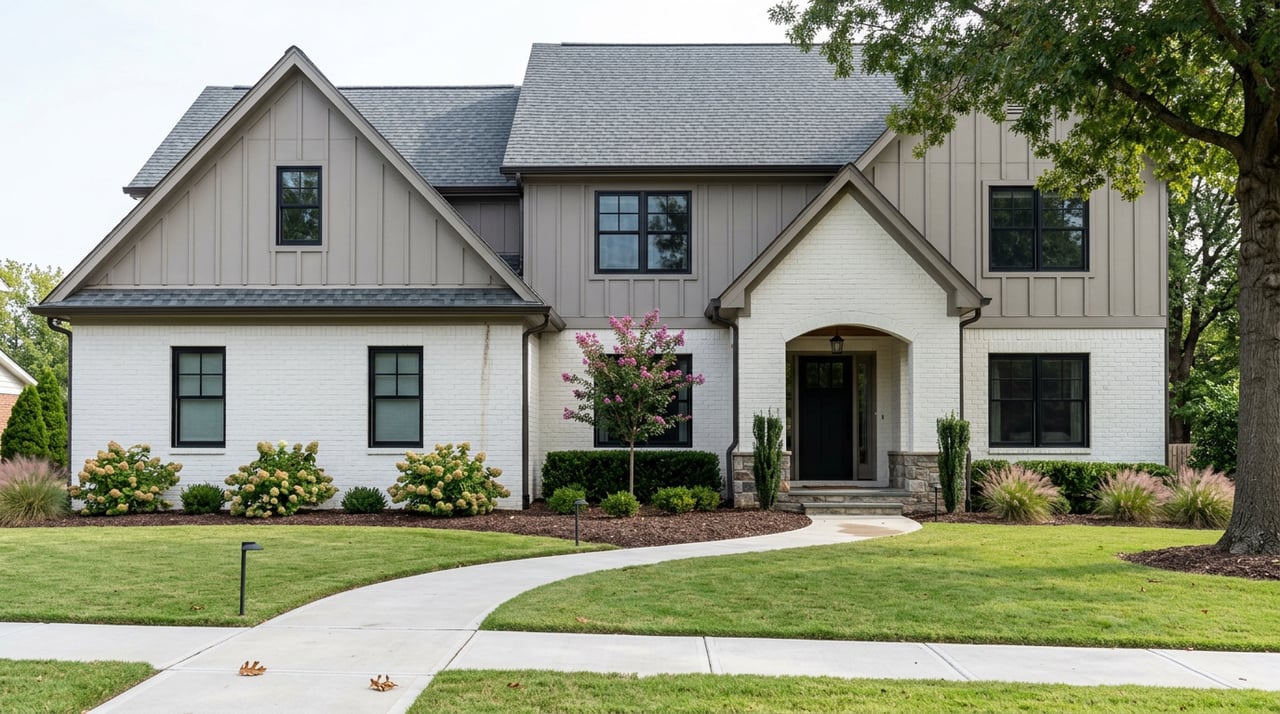
Two homes go under contract the same week, both listed with a Braselton address, both inside walking distance of the Town Green. One buyer's first tax bill lands at just under $4,500. The other buyer, a few streets over, pays closer to $3,400. Neither home is in a different school system by choice, and neither buyer negotiated a different rate. The town itself, according to its own government, collects no property tax at all. Its effective millage rate is zero.
That last fact throws people off every time. If the Town of Braselton isn't collecting ad valorem tax, why does the bill vary so much from one address to the next? The answer has nothing to do with the town and everything to do with a set of county lines that run straight through it, invisible from the sidewalk but very much present on the tax roll.
The Zero That Explains Nothing
Braselton is unusual among Georgia towns in that it doesn't fund itself through property tax. That's a real, verifiable fact, and it's one the town has stated plainly. But a buyer who hears "no property tax" and assumes their bill will be low is solving the wrong problem. The town's zero millage rate only covers the town's own slice of the bill. County government, county schools, and any special districts still apply, and those are set by whichever county actually holds jurisdiction over that specific parcel.
Braselton sits inside four counties at once: Barrow, Gwinnett, Hall, and Jackson. A house on one side of a subdivision boundary can be taxed by a completely different county government and a completely different school system than a house a few lots away. The town's name on the mailing address doesn't tell you which one applies. Only the parcel's actual county of record does.
The town's zero rate isn't a loophole buyers get to keep. It's a rounding error next to the county and school levies that make up the real bill.
What the Numbers Actually Show
Here's where the county-line effect gets genuinely counterintuitive. Based on 2026 assessment data, the Barrow County side of Braselton carries a median effective property tax rate of 1.02 percent, with a median annual bill of $4,473, the highest of any city in Barrow County. The Jackson County side carries a higher effective rate, 1.29 percent, but a lower median annual bill of $3,391.
| Barrow County side | Jackson County side | |
|---|---|---|
| Median effective tax rate (2026) | 1.02% | 1.29% |
| Median annual tax bill (2026) | $4,473 | $3,391 |
| Notable context | Highest median tax bill in Barrow County; also home to Barrow's highest median home price at $446,832 | Higher rate than Barrow, but applied to lower assessed values |
Read those two rows side by side and the obvious assumption breaks down. A higher rate should mean a higher bill, and it doesn't. The Jackson side's rate is a quarter higher than Barrow's, yet the actual dollar amount owed is nearly $1,100 less. The rate alone tells you almost nothing about what you'll pay. What matters is the rate applied to your specific home's assessed value, and home values on the Barrow side of Braselton run meaningfully higher, enough to push the median tax bill there to the top of the entire county.
For a buyer comparing two Braselton listings on paper, this is the trap. A lower posted rate on one side of town can still produce a bigger bill if the homes there are valued higher. There's no way to shortcut this with a countywide average. It has to be checked parcel by parcel.
Your Exemption Isn't the Same Exemption
The county line doesn't just change your bill this year. It changes how protected you are from increases next year, and the protections are not uniform.
In 2024, Georgia voters approved a statewide measure, House Bill 581, that lets counties adopt an adjusted base year homestead exemption to slow how fast a home's taxable value can climb. Counties and school districts each had to decide whether to opt in or out, and Braselton's four counties made different calls.
Gwinnett County opted out of HB 581 entirely. It didn't need the new statewide protection because it already has its own Value Offset Exemption, in place since 2001, which freezes the county-government portion of a homesteaded property's assessed value at its base year figure. A Gwinnett-side Braselton homeowner is protected, just under an older, county-specific mechanism rather than the new state one.
Hall County split its decision. The county opted out of HB 581 for its own general government taxes, but the Hall County School District did not opt out. That means a Braselton homeowner on the Hall County side has their school tax bill evaluated annually against two different exemption formulas, HB 581 and a local measure known as HB 1270, with whichever produces the better result for that property applied that year. Hall County's own homestead exemption guidance specifically names Braselton, along with Buford, Flowery Branch, and Gainesville, as one of the incorporated cities where this dual comparison applies.
The practical effect is that two homeowners in Braselton, one in Gwinnett, one in Hall, are protected from rising assessments by entirely different rules, filed with entirely different offices, on entirely different timelines. Neither is wrong. They're just not interchangeable, and a homestead exemption filed the way you'd expect from a prior home in a different county may not be the filing that actually helps you here.
Even the town felt the ripple. In early 2025, Braselton held public hearings on whether to opt out of the same statewide exemption for its own levy, despite already collecting zero ad valorem tax. The paperwork side of a zero-rate town still runs on the same four-county machinery as everything else.
Before You Write an Offer or List a Home
None of this shows up on a listing sheet. It surfaces at closing, or worse, on the first tax bill after move-in. A few things worth confirming before either side signs anything:
- Which county actually holds the parcel, not just which one the neighborhood is commonly associated with
- Which school system serves that specific address, since Braselton draws from four separate systems: Jackson County, Gwinnett County, Barrow County, and Hall County
- Whether a homestead exemption filed in a previous county automatically carries over, since it typically does not
- Whether the relevant school district evaluates exemptions annually (as Hall County's does) or applies a fixed formula (as Gwinnett's does)
- What the parcel's most recent assessment notice actually says, rather than relying on a citywide or countywide average
For sellers, this cuts the other way too. A buyer's lender or attorney will ask which county holds the parcel before closing, and having that answer ready, along with a clear sense of the current tax bill and which exemptions are in place, removes a friction point that otherwise turns up as a surprise during underwriting.
Braselton is also in the process of adding a new charter school downtown, Four Points Preparatory Academy, on top of the four county systems already serving different corners of town. That's one more reason the "which school district actually covers this address" question is worth asking directly rather than assuming from the town name.
None of this makes Braselton harder to buy or sell than any other North Georgia town split across jurisdictions. It just means the town's own tax story, zero rate, zero drama, is the smallest part of the picture. The real numbers live one layer down, in county offices that don't share a boundary with the name on the mailbox.
If you're comparing two Braselton addresses and want to know exactly which county, school system, and exemption rules apply before you write an offer or set a listing price, Georgia Real Estate Depot can walk through the specific parcel with you. Contact us before you assume the town name tells you the whole story.